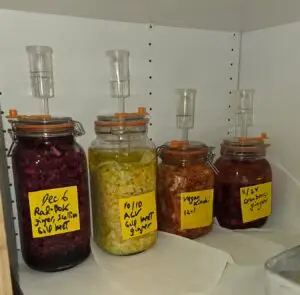
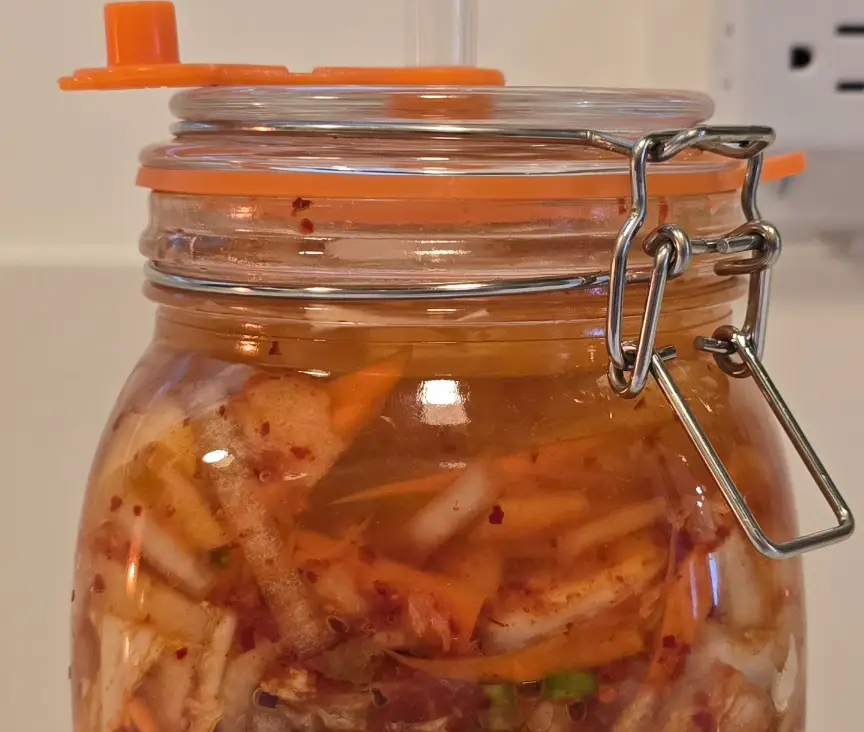
Kimchi is a popular Korean dish in the world of fermented vegetables. This version omits seafood and fish sauce, though they can be added if desired. The vegan version has a much lower odor profile while maintaining its nutritional value and unique flavors. Kimchi is famous for having all five flavors in one dish: sweet, sour, salty, bitter, and umami. However, this vegan version lacks umami, so consider adding mushrooms to achieve a more authentic taste.
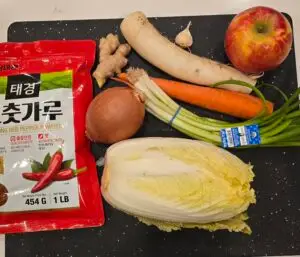
Place everything in a bowl and zero out the scale. Then, weigh everything. This will determine how much salt and chili flakes to add later. A 1.5-liter fermentation jar can hold up to 1,000 grams of raw ingredients, while a 2-liter jar can hold up to 1,500 grams. If your jar cannot hold all of your ingredients, adjust now before processing.
The photo shows all of the ingredients except for the salt. Split and chop the napa cabbage, but save one leaf for the top. Roughly chop the onion and radish. Peel and slice the apple. Julienne the carrot, or just slice it. Finely chop the garlic and peeled ginger.
Place all the chopped ingredients in a bowl and add 2% salt by weight of the original raw ingredients. Multiply your initial weight in grams by 0.02 or use the percentage function on a calculator. Sprinkle the salt on top, then mix by hand just like you would with sauerkraut. Let it sit while you clean your kitchen. Allowing a little time for the salt to work helps draw water out of the ingredients.
Next, select your preferred level of spiciness with Korean gochugaru chili flakes. There is no substitute for this type of chili pepper. You can find them in Asian markets, but I buy mine on Amazon. Or, skip the chili flakes altogether and try “White Kimchi,” which is similar to the 3,000-year-old original. Peppers originated in the New World and were not included in traditional Old World cuisine.
One tablespoon of gochugaru chili flakes equals spicy.
Two tablespoons of gochugaru chili flakes equals hot.
Three tablespoons of gochugaru chili flakes equals very hot.
More? You’re on your own!
Using either gloved hands or a large spoon, mix in the chili flakes.
Add all the ingredients to a fermentation jar and pack them down with a kraut pounder as you go. Place the reserved whole Napa cabbage leaf on top, followed by the weight. Press down. If needed, make a 2% saltwater solution and use it to fill the jar until the water level is about an inch above the weight. Do not fill the jar all the way up.
Kimchi expands quite a lot during fermentation. If the brine rises above the bubbler and comes out, simply remove the bubbler, wash it, refill it with water, and reinstall it. It is also a good idea to put paper towels and/or a tray under the fermenting kimchi.
Now comes the hard part—you have to wait ten days. It will taste good after seven days, but the extra time allows the flavors to blend even better. While it’s not wrong to ferment it longer, I can’t promise that you’ll like the flavor. You might like it, though.